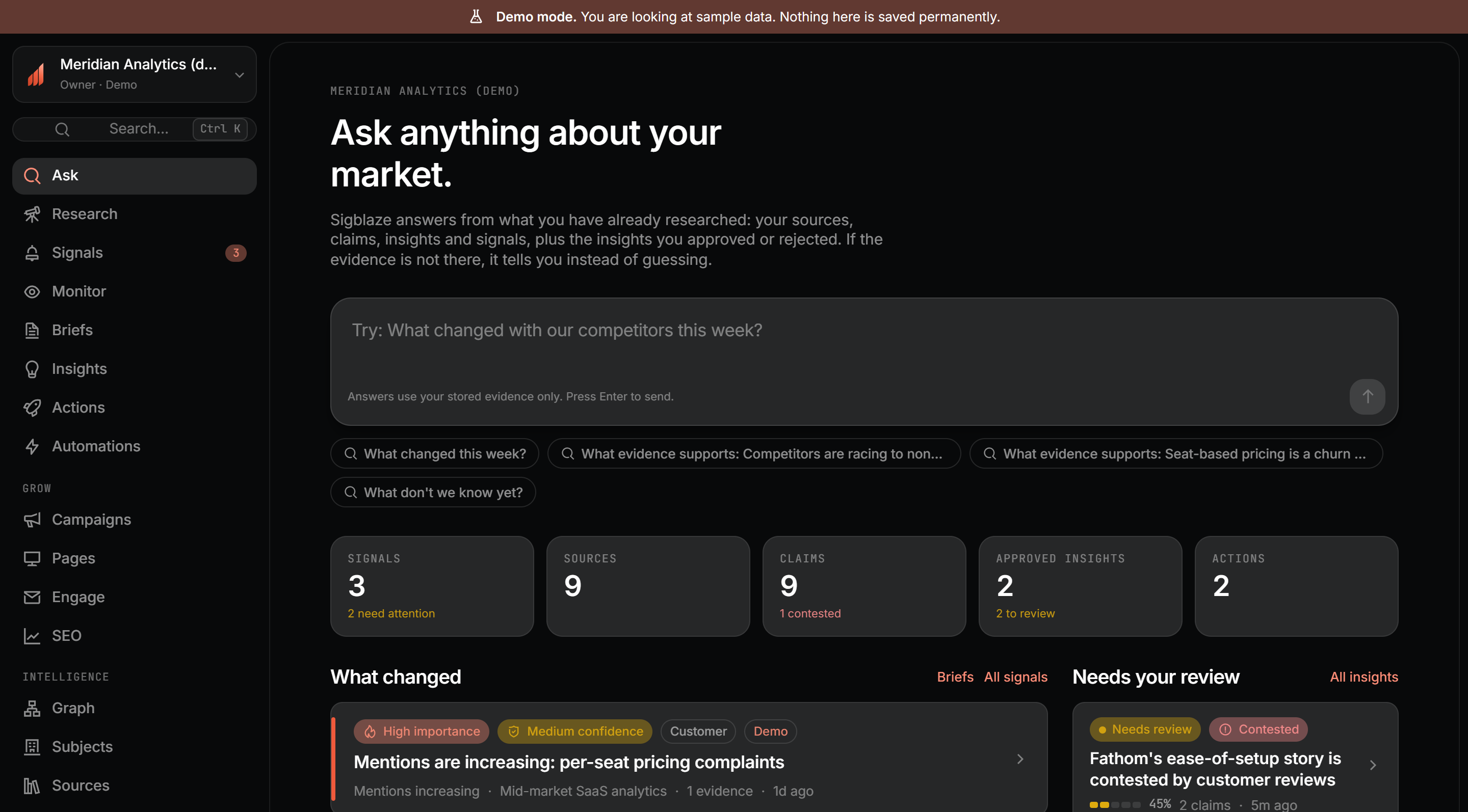
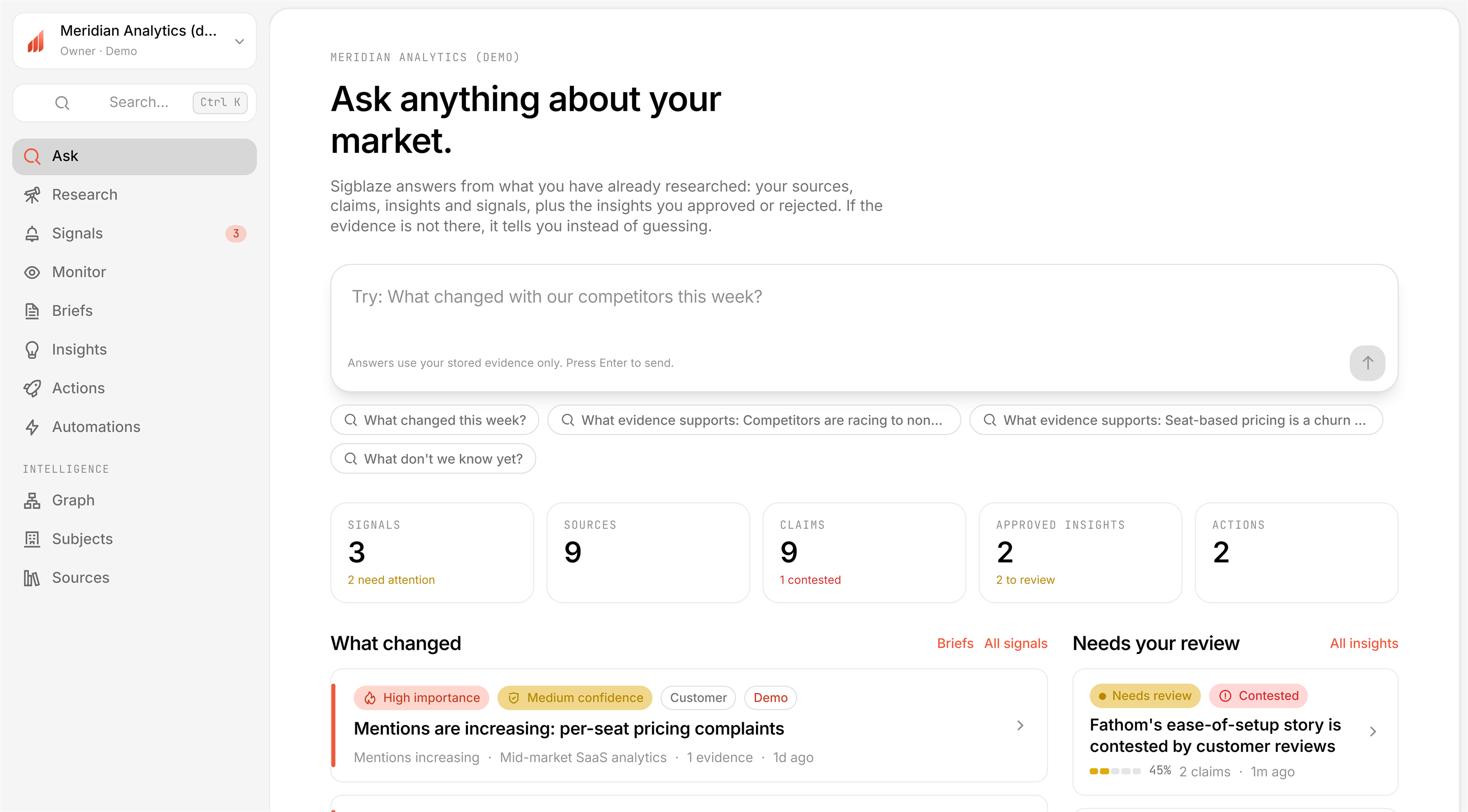
Know what’s changing in your market.Act in a few clicks.
Sigblaze tracks your market, competitors, and customers to uncover what matters. Get evidence-backed insights and clear recommendations, so you know what changed and what to do next.
Alpha. Free to start; Pro from ₹2,499 / US$29 a month.
New signal · Pricing changedMeridian Pro $49 to $59 per seat
Signals this week32 need attention
A detected change arrives with its evidence and next steps
When a watchlist check finds a difference, Sigblaze raises a signal with the before and after, an importance rating, a confidence label and the snapshots behind it.
Promote the signal to an insight, update a battlecard or add it to a brief
Each step creates a draft you review before anything is reused
One example, followed through four steps. Each step is stored and links back to the one before it.
01 · Monitor to signal
Each check is compared with the last snapshot
Add pages and searches to a watchlist. The first check is a baseline. Every later check is compared with the last stored snapshot, and a real difference becomes a signal with the before and after.
Signal raised · SG-002Pricing changed · High importance
BaselineNo change1 change
02 · Evidence and contradictions
Claims keep their sources and disagreement stays visible
Retrieved pages are stored with their type and retrieval date, then split into single-statement claims. Evidence can support, contradict or contextualise a claim. When sources disagree, the claim stays contested until a reviewer decides.
“Get your whole team live in a day. Per-seat pricing, 10-seat minimum.”
Extracted claims
C-014from S1
Meridian advertises team onboarding “in a day”.
C-021from S1
Meridian prices per seat with a 10-seat minimum.
Each claim keeps its source, so you can open the original wording.
claim / C-014
C-014 Contested
Meridian advertises team onboarding “in a day”.
S1SupportsStates it on the pricing page.
S2ContradictsReviewer reports ~5 weeks for 14 projects.
S3ContradictsClient portals migrate manually.
S4ContextualisesA CSV import shipped in July; may predate some reviews.
The claim stays contested. Nothing here picks a winner.
03 · Insight to action
Approved insights become draft actions
An insight links to the claims behind it and carries a confidence label and its freshness. Once a person approves it, it can become a battlecard, a positioning draft, a campaign direction or a report. Each action keeps a trace back to its insight.
Ask How many projects move, and who rebuilds portals?
Say Import covers projects and tasks. Confirm portal time.
Don’t say “Meridian takes weeks.” C-014 is contested.
A-003traces to I-007 · review before use
04 · Ask
Ask answers from what the workspace has stored
Questions such as “What changed this week?” are answered from stored claims, insights and signals, with citations. When the evidence is missing, Ask says so and offers to start a research run.
Three things were detected. The one that matters most: Meridian raised its Pro price from $49 to $59 per seat [SG-002, C-030]. Complaints about manual portal migration also increased [SG-004]. Tallyhouse added a Slack integration [SG-005].
SG-002C-030SG-004SG-005searched: last 7 days
Turn that into a battlecard against Meridian.
Battlecard drafted from approved insight I-007, with the price change cited. It stays a draft until you review it.
Battlecard · drafttrace → I-007
What do we know about Meridian onboarding?
Meridian advertises onboarding in a day [C-014, S1]. Two agency-side sources report multi-week migrations [C-015, S2, S3], and a July changelog entry notes a new CSV import that may have shortened this since [S4]. The evidence is contested.
C-014C-015S1S2S3S4
What is Meridian's customer churn rate?
The stored evidence does not cover this. No claim in the workspace addresses churn.
Start a research run
Ask answers from stored evidence. When there is none, it says so. A follow-up can become an action.
How Sigblaze differs from a one-off AI chat
Chat tools suit one-off questions. Recurring research needs saved context, stored sources and something that keeps watching.
One-off AI chat compared with a Sigblaze workspace
Topic
One-off AI chat
Sigblaze workspace
Context
Re-explained in every chat
Saved workspace context, reused by each run
Sources
Links in a transcript, if any
Stored with type and retrieval date
Claims
A prose summary
Single statements linked to their evidence
When sources disagree
Often blended into one answer
Kept visible, and the claim stays contested
Noticing a change
Only when you ask again
Watchlists compare snapshots and raise signals
Weekly digest
You write it
A brief built from stored signals
Review
None
A person approves or rejects before reuse
Tracing an action
Not kept
Action to insight to claims, signals and sources
Teams that research the same market again and again
Sigblaze is a market intelligence product. It researches your market, competitors and customers, checks them again on a schedule, raises a signal when something meaningful changes, and turns reviewed evidence into actions for marketing, sales, product and strategy. Sources, claims, contradictions, insights and signals are stored in the workspace, so the next question starts from what is already known.
Who is it for?
Boutique B2B agencies running research for several clients, fractional CMOs and GTM consultants, B2B SaaS teams, and founders or product marketers who research competitors and markets on a recurring basis.
How is it different from ChatGPT or Perplexity?
General AI tools are good for one-off questions and exploration. Sigblaze is built for recurring team research: it stores workspace context, keeps sources and claims, shows contradictions, preserves lineage and lets a team reuse approved intelligence in later research and actions.
How does research planning work?
You state a research goal, and the product turns it into a bounded plan of tasks and queries. Each task inherits the workspace's company, product, ICP, market and competitor context, so one vague prompt does not have to carry everything.
What is a claim?
A claim is one factual statement extracted from a source. It stays linked to the evidence that supports, contradicts or adds context to it.
What happens when sources disagree?
The disagreement is kept. A claim with contradicting evidence is shown as contested, and the system does not silently pick a preferred fact.
How are insights generated?
An insight is an interpretation written from stored claims and evidence. It keeps the claim relationships, confidence and freshness that produced it, and a person reviews it before it is reused.
Can I ask follow-up questions?
Yes. Ask answers from the workspace's stored context, claims, insights, signals and sources, including what you approved or rejected, and it can answer questions such as “what changed this week?”. When the stored evidence is not enough, it says so instead of presenting general model knowledge as workspace evidence.
Sigblaze is in alpha for agencies, fractional GTM teams and B2B SaaS teams that research the same markets on a schedule. Create a free account and add the competitors you track.